We remain fully operational. Our teams are working around the clock to ensure your deliveries continue safely.

DOWNLOAD THE APP


Copyright © 2025 Desertcart Holdings Limited
DOWNLOAD THE APP
Buy anything from 5,000+ international stores. One checkout price. No surprise fees. Join 2M+ shoppers on Desertcart.
Desertcart purchases this item on your behalf and handles shipping, customs, and support to Dominican Republic.
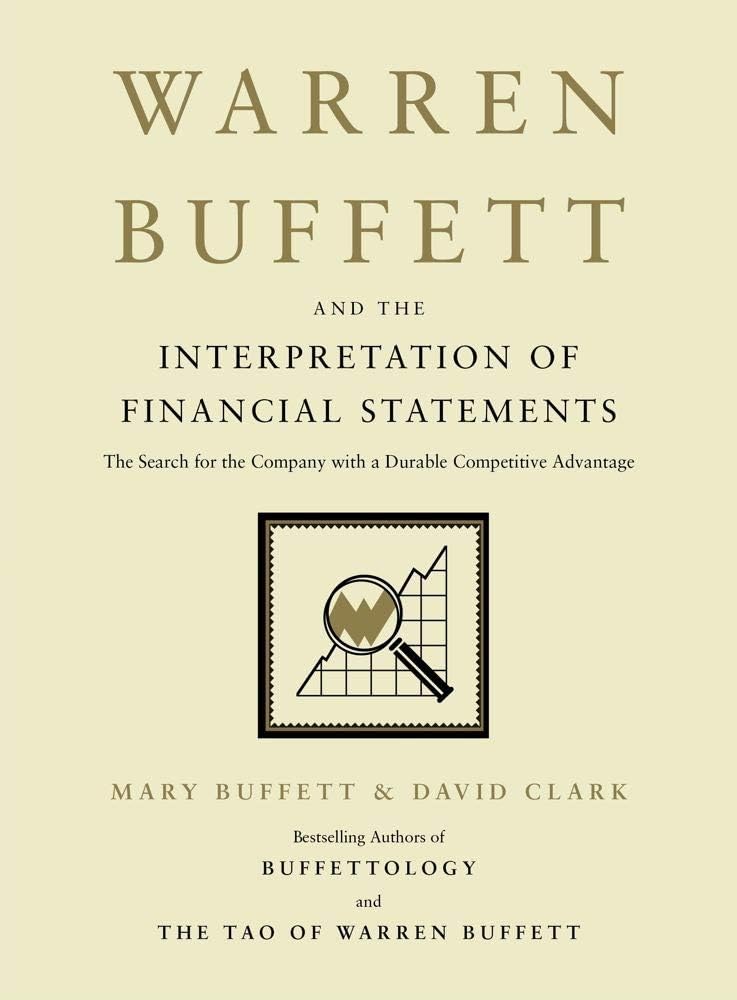
Warren Buffett and the Interpretation of Financial Statements: The Search for the Company with a Durable Competitive Advantage [Buffett, Mary, Clark, David] on desertcart.com. *FREE* shipping on qualifying offers. Warren Buffett and the Interpretation of Financial Statements: The Search for the Company with a Durable Competitive Advantage Review: Great book on interpretation of valuing - This is an excellent book/reference whether you are a novice or professional. Prior to purchasing book, I read reviews which for the most part were good to great. There were a few that criticized the content, grammar, and value of the book. I would urge you to disregard the reviews that attempted to diminish the value of this book. The book is a great book and has a tremendous amount of value. I also would add that the author was strategic in how each subject matter was provided in small doses which made it somewhat ease to digest and follow. I have no association with author as someone who has purchased many books pertaining to financial analysis of stocks and companies; if I were to buy into the very few negative reviews I would have lost a tremendous amount of value. Cudos to the author. Review: A nice learning book for non-financial people and good review book for financial people - This simplified company reports and some easy pieces to considered. Take the ideas presented in the book and practice with reports.
| Best Sellers Rank | #40,732 in Books ( See Top 100 in Books ) #11 in Financial Accounting (Books) #33 in Wealth Management (Books) #102 in Introduction to Investing |
| Customer Reviews | 4.6 4.6 out of 5 stars (3,858) |
| Dimensions | 5.63 x 0.7 x 7.5 inches |
| Edition | 1st |
| ISBN-10 | 1416573186 |
| ISBN-13 | 978-1416573180 |
| Item Weight | 12 ounces |
| Language | English |
| Print length | 224 pages |
| Publication date | October 14, 2008 |
| Publisher | Scribner |
M**E
Great book on interpretation of valuing
This is an excellent book/reference whether you are a novice or professional. Prior to purchasing book, I read reviews which for the most part were good to great. There were a few that criticized the content, grammar, and value of the book. I would urge you to disregard the reviews that attempted to diminish the value of this book. The book is a great book and has a tremendous amount of value. I also would add that the author was strategic in how each subject matter was provided in small doses which made it somewhat ease to digest and follow. I have no association with author as someone who has purchased many books pertaining to financial analysis of stocks and companies; if I were to buy into the very few negative reviews I would have lost a tremendous amount of value. Cudos to the author.
S**N
A nice learning book for non-financial people and good review book for financial people
This simplified company reports and some easy pieces to considered. Take the ideas presented in the book and practice with reports.
P**S
Key takeaways from this book
As an MBA student, I already have gone through Financial Accounting in school that's why I'll give this book 4 stars (super conservative, deserves a 5 though for those that are not aware of the financial statements). However, I loved the approach of this book towards the margins of expenses. I also used the MSN screener as suggested which is an amazing tool I wasn't using. For people interesting in a summary I'll post below the key takeaways for all the statements + the valuation. Income Statement: Margins: Gross profit margin more than 50%-60% SG&A to Gross profit have to be consistent!! Either high (50%-60%) or low (30%). Net Earning to revenues = 20%+ Interest payout less than 15% Low depreciation expense to gross profits. 10% Low R&D costs 10% 10-year growth in eps Balance Sheet: For manufacturing consistent growth in inventory. Lower percentage of net receivables to its competitors=collects more frequently money. Most companies with competitive advantage have current ratio below 1 = they earning power is so strong they can cover their current liabilities and pay generous dividends and stock repurchases that diminish cash. Current ratio is not an indicator of competitive advantage. Property plant and equipment: no frequent updates/re purchases before it wears out, to keep up. Finance new plants internally. Businesses with a competitive advantage never sell below their book value because of good will. If good will stays the same that means the company is not making new acquisitions or they are paying under the book value for a business. When businesses sell below book value with an increasing goodwill it’s a lifetime opportunity. Intangibles: brand names of Coca Cola are not carried as assets on they balance sheet. Long-term earnings power. Log-term investments: cost or market price, which ever is lower. Return on assets: more could be less in the long term. Moodys 1.5B and 45% return can be taken over if the capital is raised. But $43B and 12 of Coca Cola is an impossible task. Low to no long-term debt. Sufficient net earnings to pay all of the long-term debt within 3 to 4 years. Minority Interest: represents the excess percentage of a business we own more than 80%. If we purchase more than 80% of the business we merge their balance sheet with ours. In this case, the 20% remaining value will be carried under minority interest to balance the equation. Debt to equity below 1: the lower the better. If it’s negative they spend all the shareholders equity to buy back shares = tremendous earnings power. Add the treasury stock back to stockholders equity. No preferred stock = strong earnings Growth in retained earnings 7% or more constant over 5 years. Net earnings / shareholders equity = 30% not competitive industry. ROE Negative shareholders equity: * Companies going bankrupt: negative net and sh. equity * Companies so profitable don’t need to retain earnings. Positive net and negative sh .eq Cash-flow statement Low or No having capital expenditures= less than 20% Total 10 year Capex / Total 10 year net earning = less that 50% needs more research less that 25% is amazing. Historical share repurchases: “issuance (retirement) of stock, Net” Valuation The “bond” is the company’s equity/shares and “coupon payments” the pre-tax earnings not dividends. Stock price: $6.50 a share Pre tax earnings: $.70 a share After tax: $.46 a share Historical (10 year) Annual rate earnings:15% Bought an equity “bond” with pre-tax interest rate of 10.7% on his $6.5 investment. Long-term interest rates at 6.5% and pre-tax / coupon payments of $54 a share, would be worth $830 a share. And was selling for $726-$885.
J**T
This book is FANTASTIC!!
I gave this book five stars, but if I could more stars I most definitely would have! If was direct and to the point, while explaining perfectly the concepts and rules as Warren Buffett analyses a company’s financial statements. Adding insight when to look at details of past financial performance. I read it in a few hours due to not being able to put it down. Thank you for sharing the depth and breathe of Warren’s interpretation of a company’s financial statements to identify those companies with a durable competitive advantage! EXCELLENT JOB!!
D**R
VERY INTERESTING AND EDUCATIONAL
First ever Warren Buffett book for me. Now I want to learn more about the stock investment business. This book is a very easy read.
W**W
It's a good start.
The author is the former wife of Warren Buffet's son. The language she uses is friendly and easily comprehensible. The author touches on some key things that Buffet looks for in a stock. It is by no means an exhaustive list. To prepare to read this book, you should have a firm grasp of financial statements: income statement, balance sheet, and cash flow statement. It is a short book. I would say it is best for those beginning to study value investing and fundamental analysis.
R**Y
Book
Excellent book
U**U
Strong start and Poor Finish
Having done an MBA, I can certainly claim to have been introduced to the basic concepts of Finance. I was looking for a street-smart view of the interpretation of these statements since I had the book-smart view from the text books. The first few sections slowly introduced the concepts in each of the statements - Income, Balance Sheet and Cash Flow. There were a few repetitive things in those sections. However, there were some good perspectives and rules of thumb for the key metrics that one need to watch out for (gross profit > 40%; Adjusted Debt to Equity ratios low; Adjusted Return on Equity etc) - Exactly what I was looking for. With such a decent and reasonably strong foundation laid over the introductory chapters, I was expecting a very good finish in the final sections of valuation. When it came down to the Finale, it was a TOTAL let down. It reminded me of the exams where one just fills out the answer sheets as soon as one possibly can before the final bell rings - even if it meant blabbering all your way through in the final few minutes. The valuation examples were inconsistent (One chapter says Coke grew 10% on a metric for 15 years and the next chapter said it grew 15% on the same metric for 15 years). There was no explanation for any of the terms suddenly introduced (Pre-tax earnings and calculations related to corporate interest rate). A 3 out of 5 for a decent start that failed to finish.
M**Z
The main goal of this book is to be easy and it achieved that 100%. Shorts sentences, good examples and we navigate through till the end in a blink of an eye. This book does not bring Octus Pocus prescription or formula to be rich in a couple of days or months. It brings a way of finance dealing for results to 20, 30 years ahead. It helps us pick good companies - with consistent returns and competitive edge - and stick to that, year after year, leaving the taxman at the door waiting to collect the tax over our profits as long as possible. But it also teaches us how to get rid of some once excellent picks at the right time: business better positioned to the future, stocks too high to ignore (40 eps or more), change of the business environment (no one uses fax anymore). I loved the bond methodology too (last 3 or 4 chapters). Five stars for sure.
L**N
Great book, includes basic information on the financial statements, how Buffett thinks and more.
M**E
Nice to amplify your investing intelligence and understanding how Buffet invest his money
O**S
Très bon livre pour approfondir le côté financier, clairement. Beaucoup de livres de finance ne parlent que qualitativement, mais celui-ci est le premier livre qu'il faut lire sur la partie quantification. Si vous aimez acheter vos actions intelligemment avec toutes les cartes en main, il est nécessaire. J'avoue ne pas appliquer toutes les analyses pour chaque entreprise, mais le livre ouvre la voix.
O**N
Great book, I loved how brief every metric in value investing is described. Highly recommend for the beginners
Trustpilot
1 month ago
3 days ago